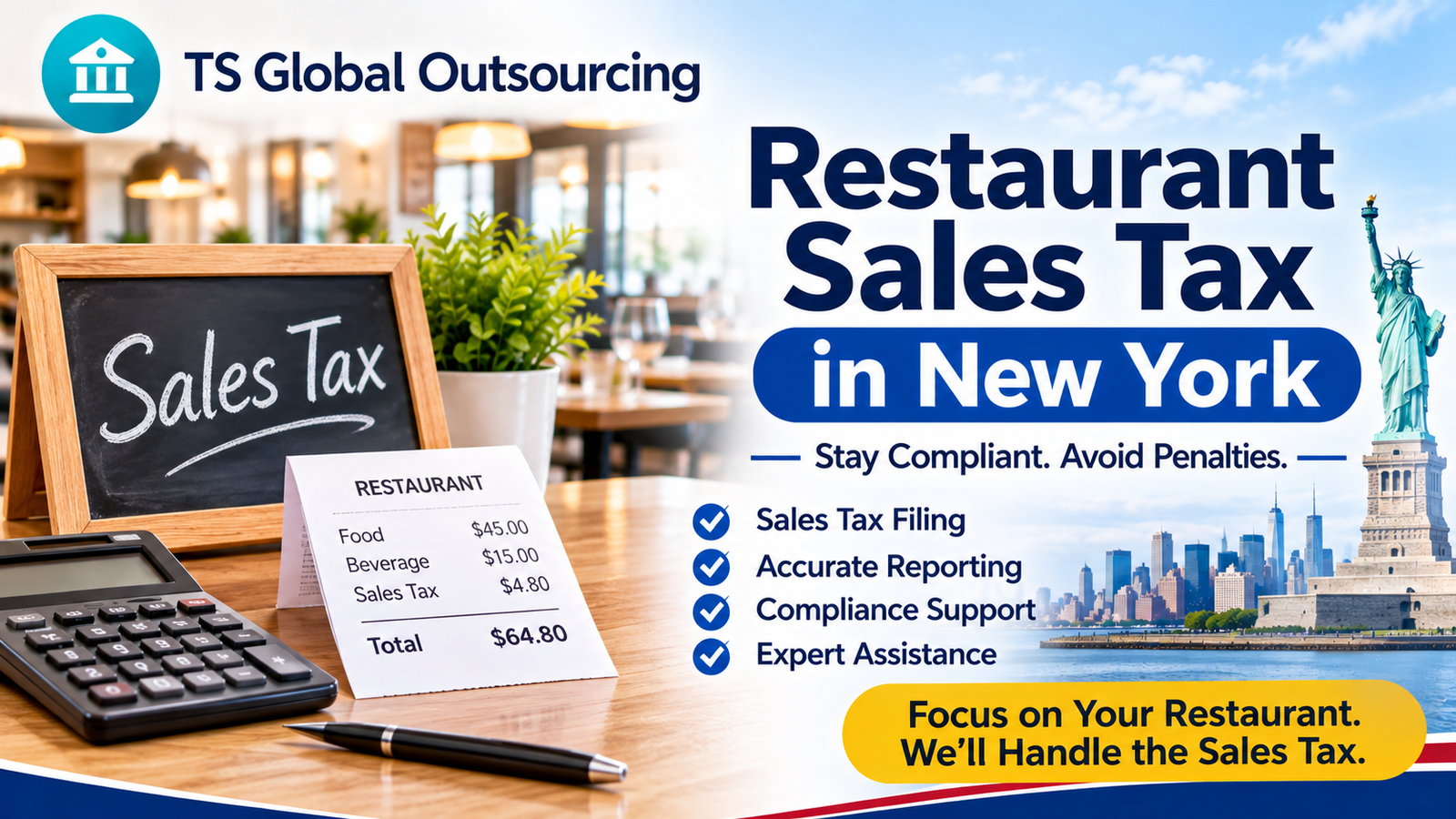
Restaurant sales tax becomes dangerous when owners treat it as money the restaurant earned.
A busy New York restaurant can collect thousands of dollars of sales tax during a reporting period. That money may sit in the same bank account as operating cash, making the restaurant appear more liquid than it really is.
Then filing time arrives.
The business discovers that part of the money it has already spent was never operating profit in the first place.
This is why sales-tax bookkeeping is not simply a compliance exercise. It is a cash-management issue.
Restaurant owners need accounting records that separate operating revenue from taxes collected, reconcile the POS system with the books, and make the outstanding sales-tax liability visible before a payment deadline arrives.
TS Global Outsourcing provides accounting services for restaurants in New York, including monthly bookkeeping, POS reconciliation, sales-tax support, payroll support, cleanup bookkeeping, and financial reporting. The purpose is to make restaurant books reliable enough that tax obligations can be traced to the activity that created them.
This guide focuses on the accounting side of New York restaurant sales tax: how records should be organized, why discrepancies appear, what owners should review, and how bookkeeping can prevent unpleasant surprises.
Specific taxability questions, rates, filing frequencies, exemptions, and legal interpretations should always be checked against current New York State Department of Taxation and Finance guidance or a qualified tax professional.
Why Restaurant Sales Tax Creates Bookkeeping Problems
Restaurants process a large number of small transactions.
Those transactions may be split across:
Dine-in.
Takeout.
Delivery.
Catering.
Private events.
Alcohol.
Gift cards.
Service charges.
Online ordering.
Third-party delivery platforms.
Cash.
Credit cards.
Each system may report information differently.
The accounting books then need to bring all of that activity into one coherent financial record.
If the bookkeeper records only net bank deposits, the restaurant may lose visibility into gross sales and tax collected.
If the POS is configured incorrectly, sales-tax data can be wrong before the accounting process even begins.
If delivery platforms handle certain tax amounts differently from direct restaurant sales, the bookkeeper needs to understand the flow instead of assuming every payout follows the same structure.
That is why restaurant sales tax needs reconciliation, not just a quarterly journal entry.
Sales Tax Collected Is Not Operating Revenue
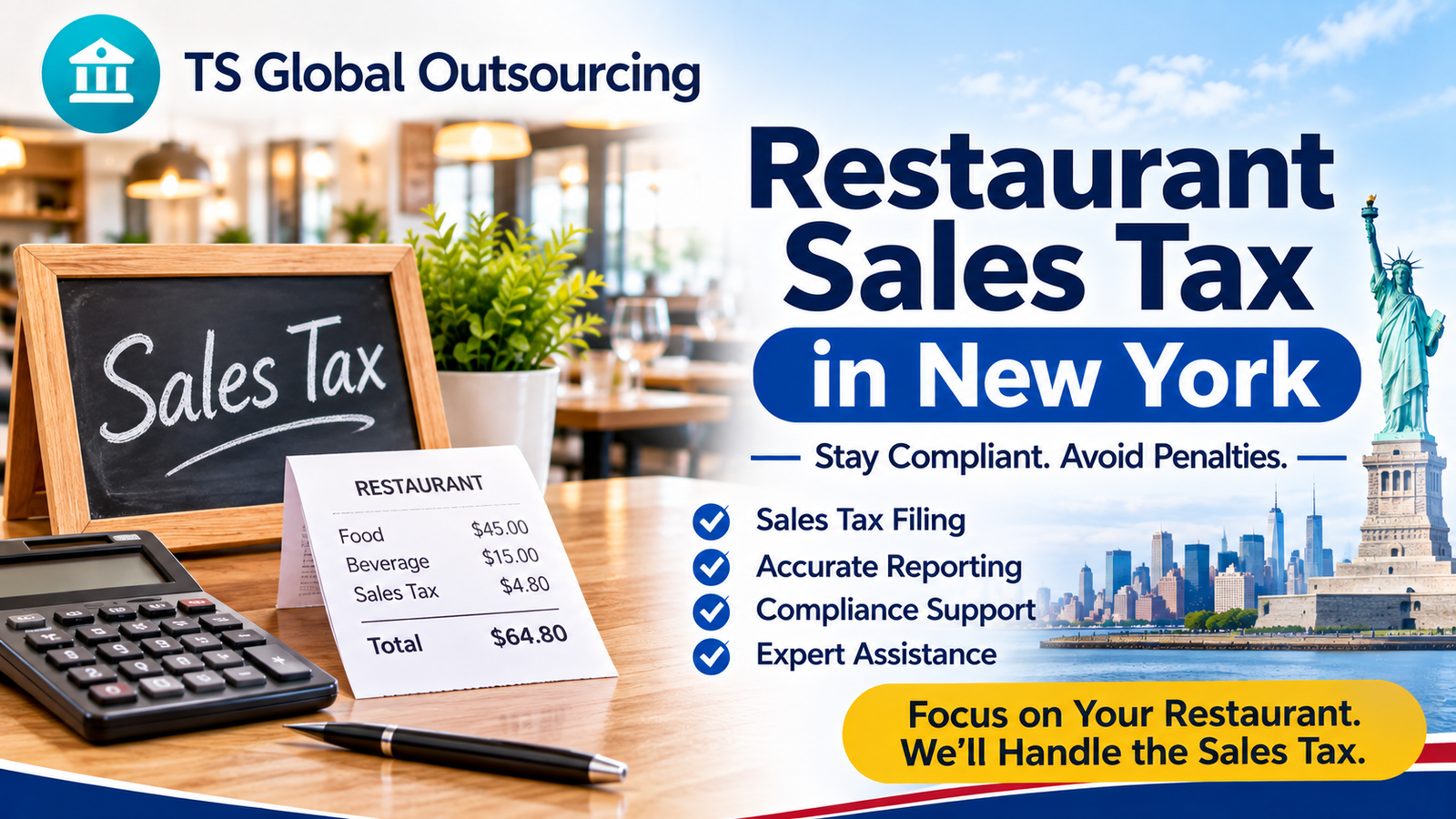
When a restaurant collects tax from a customer, that amount is generally not part of the restaurant’s earned food or beverage revenue.
From a bookkeeping perspective, the tax should normally be separated into a liability account until it is remitted.
Consider a simplified example.
Food and beverage sales: $100,000.
Sales tax collected: $8,000.
Customer payments: $108,000.
If the accounting system records all $108,000 as sales, the restaurant appears to have more revenue than it actually earned.
That can distort food-cost percentages, labor percentages, profit margin, management reporting, and tax planning.
The financial statements should distinguish business revenue from amounts collected on behalf of a taxing authority.
How Sales Tax Flows Through Restaurant Books
A restaurant sales-tax workflow generally has three stages.
First, the customer purchase creates taxable sales and tax collected.
Second, payment is received through cash, cards, online ordering, or another channel.
Third, the restaurant remits the required tax according to its filing obligations.
The accounting system should reflect all three stages.
The sales-tax liability increases when tax is collected.
It decreases when the tax is paid.
At the end of a reporting period, the remaining liability should make sense relative to the restaurant’s recent taxable sales and filing activity.
If the balance is negative, extremely large, or unchanged for months, the account needs review.
Why the POS Configuration Matters
The POS system is the starting point for most restaurant sales data.
If menu items are mapped incorrectly, bookkeeping cannot fix every issue automatically after the fact.
Restaurants should make sure the POS distinguishes relevant sales categories and tax settings.
The system should also correctly handle refunds, discounts, voids, service charges, tips, gift cards, and other items according to applicable requirements.
Whenever a restaurant changes its menu, adds a new ordering channel, introduces a fee, or starts catering, management should consider whether the POS tax setup needs review.
The POS is not just an operational tool. It feeds the financial records.
Dine-In, Takeout, Delivery, and Other Sales Channels
Restaurant businesses often sell the same food through several channels.
The accounting team should understand how each channel reports gross sales, tax, fees, discounts, and payouts.
A dine-in POS transaction may flow directly through the restaurant’s merchant account.
An online-ordering transaction may be settled through a different processor.
A third-party delivery order may be reported on a marketplace statement with commissions and adjustments.
The bookkeeping process should preserve enough detail to trace the sales-tax amounts back to the source reports.
Simply combining every deposit into one revenue line removes that visibility.
Delivery Apps and Sales Tax Records
Delivery platforms can create confusion because the customer-facing order value may be very different from the net payout received by the restaurant.
The platform statement may include:
Gross food sales.
Tax.
Delivery-related charges.
Promotions.
Refunds.
Commissions.
Marketing fees.
Adjustments.
Net payout.
The bookkeeper should not assume the bank deposit itself represents taxable restaurant sales.
Instead, delivery-platform activity should be reconciled from gross order activity to the final payout.
Our dedicated guide to reconciling Uber Eats, DoorDash, and Grubhub payouts explains that workflow in more detail.
For tax treatment, restaurants should confirm the current responsibilities applicable to marketplace transactions and their specific setup.
Sales Tax and Restaurant Discounts
Discounts affect the amount the customer ultimately pays and can affect how taxable sales appear in the POS.
The accounting team should make sure discount activity is consistently captured.
Promotional discounts should not become unexplained reductions in bank deposits.
They should be visible enough that management can understand both the marketing cost and the sales-tax effect according to applicable rules.
A restaurant running frequent happy-hour, loyalty, staff, influencer, or third-party promotions needs a POS structure that captures those adjustments clearly.
Sales Tax and Refunds
Refunds reverse part or all of a prior transaction.
The accounting system should make sure the related sales and tax adjustments are not simply recorded as miscellaneous expenses.
A high volume of refunds can also be an operational signal.
Management may want to understand whether refunds come from delivery problems, order errors, customer complaints, duplicate charges, or POS mistakes.
Good bookkeeping preserves that visibility.
Service Charges, Fees, and Taxability Questions
Restaurants may add mandatory service charges, banquet charges, administrative fees, delivery fees, or other amounts.
The tax and payroll treatment of these charges can differ depending on the facts and applicable rules.
This is an area where restaurant owners should avoid relying on assumptions.
The POS should clearly identify each charge.
The accounting system should use consistent categories.
Qualified tax advice should determine the correct treatment.
From a bookkeeping perspective, unclear fees should never be buried in ordinary sales without documentation.
How to Reconcile Sales Tax Monthly
A monthly sales-tax reconciliation can compare:
POS taxable sales.
POS tax collected.
Delivery-platform reports.
Online-ordering reports.
Accounting revenue.
Sales-tax liability.
Prior filings.
Payments made.
The purpose is to identify differences before filing time.
If the POS shows one amount of tax but the accounting system shows another, investigate the difference.
Possible causes include missing sales, duplicate entries, delivery-platform treatment, refunds, timing differences, incorrect journal entries, or prior-period adjustments.
Do not force the numbers to agree with an unexplained plug.
The Sales Tax Liability Account
The sales-tax liability account should tell a clear story.
Tax is collected.
The liability increases.
Tax is paid.
The liability decreases.
If bookkeeping is working correctly, the account should broadly reflect the restaurant’s outstanding obligation.
Old unexplained balances are a warning sign.
A liability that has remained unchanged for a year may indicate that payments were never posted correctly.
A negative liability may indicate duplicate payments or incorrect entries.
The account should be reconciled just like other important balance-sheet accounts.
Why Bank Deposits Do Not Equal Taxable Sales
This is one of the most common restaurant bookkeeping misconceptions.
Bank deposits can include or exclude many items that have nothing to do with taxable sales.
A deposit may include tips.
A delivery payout may be net of commissions.
A merchant deposit may be net of processing fees.
A bank transfer may be owner funding.
A loan deposit may increase cash without creating sales.
A gift-card sale may create cash before redemption.
A catering deposit may relate to a future event.
That is why restaurant sales tax should be reconciled to sales systems, not calculated from bank deposits alone.
How Restaurant Sales Tax Errors Start
Most major problems begin as small process weaknesses.
The POS is configured incorrectly.
Someone changes a menu tax setting without telling the bookkeeper.
Delivery platforms are recorded net.
Refunds are posted inconsistently.
Sales tax is mixed with revenue.
A payment is recorded against the wrong liability account.
The restaurant changes providers and loses historical reports.
Cash sales are omitted.
The business opens a second location but keeps using one undifferentiated sales account.
Months later, the books no longer agree with filings.
Strong monthly bookkeeping prevents small differences from accumulating.
Common Restaurant Sales Tax Bookkeeping Mistakes
Recording tax as revenue.
Calculating tax from net bank deposits.
Ignoring delivery-platform reports.
Failing to reconcile the tax liability.
Posting sales-tax payments as operating expense.
Mixing tax payments with income-tax payments.
Using one revenue account for every sales channel.
Failing to review refunds.
Treating all service charges the same.
Ignoring cash sales.
Failing to preserve filed returns.
Not tying accounting records back to filings.
These problems can make both management reporting and future cleanup more difficult.
Sales Tax and Cash Sales
Cash sales still need to be included in the restaurant’s sales records.
A cash-heavy restaurant should compare POS cash activity with deposits, documented cash uses, tip handling, and cash-on-hand procedures.
If cash sales are recorded inconsistently, the restaurant can end up with incorrect revenue and sales-tax records.
Good cash controls support both accurate bookkeeping and operational accountability.
Sales Tax and Gift Cards
Gift cards require careful accounting because the timing of cash receipt and the underlying restaurant sale may differ.
The restaurant may receive cash when the card is sold but provide food later when it is redeemed.
The precise tax and accounting treatment depends on the facts and applicable rules.
From a bookkeeping perspective, owners should make sure gift-card sales and redemptions are separately tracked so revenue is not duplicated and the related tax treatment can be handled consistently.
Sales Tax for Catering and Private Events
Catering and private events can add complexity.
The invoice may include food, beverages, rentals, service charges, staffing, deposits, venue fees, or other components.
Restaurants should not assume every component receives identical tax treatment.
The accounting system should keep event invoices detailed enough for the restaurant and tax professional to review.
Deposits should also be tracked so the business knows how much has been collected and how much remains due.
Sales-tax bookkeeping works best when the underlying invoice is clear.
Multi-Location Restaurant Sales Tax
Restaurant groups should maintain enough detail to understand sales and tax by location.
Each location may have different POS terminals, bank accounts, delivery accounts, and operational procedures.
Management should be able to answer:
What were taxable sales at each location?
How much sales tax was recorded?
Were returns filed?
Were payments made?
Does the liability reconcile?
A consolidated accounting system should not eliminate location-level accountability.
Our guide to multi-location restaurant accounting explains how financial statements can preserve both consolidated and store-level visibility.
What Restaurant Owners Should Review Before Filing
Before a filing is finalized, owners or their accounting team should make sure the source data is complete.
Review:
POS sales reports.
Delivery-platform reports.
Online-ordering sales.
Refunds.
Discounts.
Cash sales.
Catering.
Private events.
Gift-card activity.
Service charges.
Prior-period adjustments.
Sales-tax liability.
Payments already made.
The goal is not for the owner to redo the tax calculation personally.
The goal is to make sure the records feeding the filing reflect the actual restaurant activity.
How Bookkeeping Supports Sales Tax Filing
Sales-tax filing becomes much easier when bookkeeping is current.
The accountant can trace reported sales to monthly records.
Payments can be matched to the liability account.
Differences can be investigated while source reports are still accessible.
If bookkeeping is six months behind, sales-tax preparation often turns into a reconstruction project.
That increases cost and risk.
Monthly accounting creates a cleaner foundation.
What to Do When Sales Tax Records Do Not Match
Do not simply overwrite one system to match another.
First determine where the difference begins.
Compare the POS to delivery platforms.
Compare gross sales to accounting revenue.
Compare recorded tax to the liability.
Compare payments to filed returns.
Check whether entries were duplicated.
Review timing differences.
Check prior adjustments.
If the discrepancy spans several months, it may require a formal restaurant bookkeeping cleanup.
Document every correction so future accountants understand what changed.
Restaurant Sales Tax Cleanup
A restaurant may need sales-tax cleanup when:
Tax has been recorded as revenue.
Filings do not match accounting records.
The liability balance is unexplained.
Payments were posted incorrectly.
POS reports are missing.
Delivery apps were never reconciled.
Multiple locations were combined incorrectly.
Prior periods contain significant adjustments.
Cleanup should rebuild the flow from source sales reports through the general ledger and filed returns.
The objective is not merely to make the balance sheet look tidy.
It is to create a documented trail that can be maintained going forward.
Sales Tax and Tax Season
Sales tax is separate from the restaurant’s income-tax return, but poor sales-tax bookkeeping can still complicate year-end accounting.
If revenue has been recorded including tax, annual sales may be overstated.
If tax payments have been treated as ordinary expenses, the Profit and Loss statement may be distorted.
If the liability account is wrong, the balance sheet is unreliable.
Cleaning these issues before income-tax preparation helps the tax professional start with more accurate books.
How Often Should Restaurant Sales Tax Be Reviewed?
Restaurants should not wait until a filing deadline to look at sales tax.
A monthly review is useful even when the restaurant files on another schedule.
The bookkeeper can reconcile the liability as part of the month-end close.
Owners can also monitor the balance so tax cash is not accidentally treated as free operating cash.
Frequent review reduces surprises.
Choosing an Accountant for Restaurant Sales Tax Support
Ask potential providers:
Do you understand restaurant POS systems?
Will you reconcile gross sales rather than only bank deposits?
Can you work with delivery-platform reports?
How do you track sales tax in the books?
Can you reconcile the liability account?
Do you help prepare sales-tax records?
Can you support filing?
How do you handle multiple locations?
Can you clean up historical discrepancies?
How quickly are monthly books closed?
The best provider should connect sales-tax support with the restaurant’s entire accounting workflow.
How TS Global Outsourcing Helps Restaurants
TS Global Outsourcing provides New York restaurants with bookkeeping and accounting support designed around transaction-heavy businesses.
Services can include:
Monthly bookkeeping.
POS reconciliation.
Bank and credit-card reconciliation.
Sales-tax support.
Payroll support.
Delivery-platform reconciliation.
AP and AR support.
Cleanup bookkeeping.
Financial reporting.
Multi-location accounting.
Restaurant owners can combine these functions depending on their current systems and needs.
For businesses comparing service scope, our restaurant accounting cost guide explains how complexity affects monthly pricing.
Frequently Asked Questions About Restaurant Sales Tax in New York
Is restaurant sales tax revenue?
Tax collected from customers should generally be tracked separately from operating restaurant revenue. It represents an amount the business may owe rather than income earned from food or beverage sales.
Can I calculate restaurant sales tax from bank deposits?
Bank deposits are not a reliable substitute for sales records because deposits may be net of fees, include tips, contain transfers, or reflect timing differences. Use source sales reports and applicable tax rules.
Does the POS sales-tax report need to match the books?
The records should be reconcilable. Differences should be understood and documented rather than ignored.
Do delivery apps affect sales-tax bookkeeping?
Yes. Delivery platforms can create separate sales, tax, fee, and payout records. Restaurants should reconcile platform reports rather than recording only net payouts.
How should sales-tax payments be recorded?
They should generally reduce the related sales-tax liability rather than automatically being treated as an ordinary operating expense. The exact bookkeeping setup should be reviewed by the restaurant’s accountant.
What happens if sales tax was recorded as revenue?
The books may overstate restaurant sales and distort margins. A cleanup entry may be required after reviewing the underlying transactions.
How often should the sales-tax liability be reconciled?
A monthly reconciliation is useful because it identifies discrepancies before they accumulate.
Can TS Global help with restaurant sales-tax bookkeeping?
Yes. TS Global provides bookkeeping and sales-tax support for businesses, including restaurants.
Does a service charge have the same tax treatment as a tip?
Not necessarily. Mandatory charges and voluntary tips can have different implications. Restaurants should confirm treatment under current applicable rules.
Do gift cards create sales-tax accounting issues?
They can because the timing of cash receipt and redemption differs. Restaurants should track gift-card activity separately.
How should catering be handled?
Catering invoices should separate the components of the transaction clearly so the applicable tax treatment can be determined correctly.
Does sales-tax bookkeeping matter for income-tax preparation?
Yes. Incorrect sales-tax accounting can distort annual revenue, expenses, and liabilities, making year-end financial statements less reliable.
What should I do if prior filings do not match QuickBooks?
Gather the filed returns, POS reports, delivery reports, bank statements, and accounting records and perform a structured reconciliation. Significant historical differences may require cleanup.
Can sales-tax support be combined with monthly bookkeeping?
Yes. Integrating the two is often efficient because the bookkeeper already has access to the sales and bank information needed for reconciliation.
Can TS Global support multiple restaurant locations?
Yes. Restaurant accounting can be structured with location-level sales and tax records while also providing consolidated reporting.
Keep Sales Tax Separate, Reconciled, and Visible
Restaurant sales tax should never become a mystery balance that receives attention only when a filing is due.
The restaurant should know how much taxable activity was recorded, how much tax was collected, what has been paid, and what remains outstanding.
That requires three systems to work together:
The sales systems.
The accounting records.
The filing process.
When they agree, sales-tax compliance becomes easier and cash-flow planning becomes more reliable.
When they do not agree, owners risk spending money that was never truly operating cash and handing tax preparers books that need major reconstruction.
If your restaurant’s sales-tax liability does not make sense, POS reports do not agree with the books, or delivery platforms have never been reconciled, TS Global Outsourcing can help organize and clean the accounting process.
Explore TS Global Outsourcing’s accounting services for restaurants and broader bookkeeping, payroll, and tax services to build a more reliable monthly financial system for your New York restaurant.